# *this* 指向
## 经典真题
- *this* 的指向哪几种 ?
## *this* 指向总结
*this* 关键字是一个非常重要的语法点。毫不夸张地说,不理解它的含义,大部分开发任务都无法完成。
*this* 可以用在构造函数之中,表示实例对象。除此之外,*this* 还可以用在别的场合。**但不管是什么场合,*this* 都有一个共同点:它总是返回一个对象**。
关于 *this* 的指向,有一种广为流传的说法就是“谁调用它,*this* 就指向谁”。
这样的说法没有太大的问题,但是并不是太全面。总结起来,*this* 的指向规律有如下几条:
- 在函数体中,非显式或隐式地简单调用函数时,在严格模式下,函数内的 *this* 会被绑定到 *undefined* 上,在非严格模式下则会被绑定到全局对象 *window/global* 上。
- 一般使用 *new* 方法调用构造函数时,构造函数内的 *this* 会被绑定到新创建的对象上。
- 一般通过 *call/apply/bind* 方法显式调用函数时,函数体内的 *this* 会被绑定到指定参数的对象上。
- 一般通过上下文对象调用函数时,函数体内的 *this* 会被绑定到该对象上。
- 在箭头函数中,*this* 的指向是由外层(函数或全局)作用域来决定的。
当然,真实环境多种多样,下面我们就来根据实战例题逐一梳理。
### 全局环境中的 *this*
例题 *1*:
```js
function f1() {
console.log(this);
}
function f2() {
'use strict'
console.log(this);
}
f1(); // window or global
f2(); // undefined
```
这种情况相对简单、直接,函数在浏览器全局环境下被简单调用,在非严格模式下 *this* 指向 *window*,在通过 *use strict* 指明严格模式的情况下指向 *undefined*。
虽然上面的题目比较基础,但是需要注意上面题目的变种,例如
例题 *2*:
```js
const foo = {
bar : 10,
fn : function(){
console.log(this); // window or global
console.log(this.bar); // undefined
}
}
var fn1 = foo.fn;
fn1();
```
这里的 *this* 仍然指向 *window*。虽然 *fn* 函数在 *foo* 对象中作为该对象的一个方法,但是在赋值给 *fn1* 之后,*fn1* 仍然是在 *window* 的全局环境下执行的。因此上面的代码仍然会输出 *window* 和 *undefined*。
还是上面这道题目,如果改成如下的形式
例题 *3*:
```js
const foo = {
bar : 10,
fn : function(){
console.log(this); // { bar: 10, fn: [Function: fn] }
console.log(this.bar); // 10
}
}
foo.fn();
```
这时,*this* 指向的是最后调用它的对象,在 *foo.fn( )* 语句中,this 指向的是 *foo* 对象。
### 上下文对象调用中的 *this*
例题 *4*:
```js
const student = {
name: 'zhangsan',
fn: function () {
return this;
}
}
console.log(student.fn() === student); // true
```
在上面的代码中,*this* 指向当前的对象 *student*,所以最终会返回 *true*。
当存在更复杂的调用关系时,如以下代码中的嵌套关系,*this* 将指向最后调用它的对象,例如
例题 *5*:
```js
const student = {
name: 'zhangsan',
son: {
name: 'zhangxiaosan',
fn: function () {
return this.name
}
}
}
console.log(student.son.fn()); // zhangxiaosan
```
在上面的代码中,*this* 会指向最后调用它的对象,因此输出的是 *zhangxiaosan*。
至此,*this* 的上下文对象调用已经介绍得比较清楚了。我们再来看一道比较高阶的题目
例题 *6*:
```js
const o1 = {
text: 'o1',
fn: function () {
return this.text;
}
}
const o2 = {
text: 'o2',
fn: function () {
return o1.fn();
}
}
const o3 = {
text: 'o3',
fn: function () {
var fn = o1.fn;
return fn();
}
}
console.log(o1.fn()); // o1
console.log(o2.fn()); // o1
console.log(o3.fn()); // undefined
```
答案是 *o1、o1、undefined*。
这里主要讲一下为什么第三个是 *undefined*。这里将 *o1.fn* 赋值给了 *fn*,所以 *fn* 等价于 *function () { return this.text; }*,然后该函数在调用的时候,是直接 *fn( )* 的形式调用的,并不是以对象的形式,相当于还是全局调用,指向 *window*,所以打印出 *undefined*。
### *this* 指向绑定事件的元素
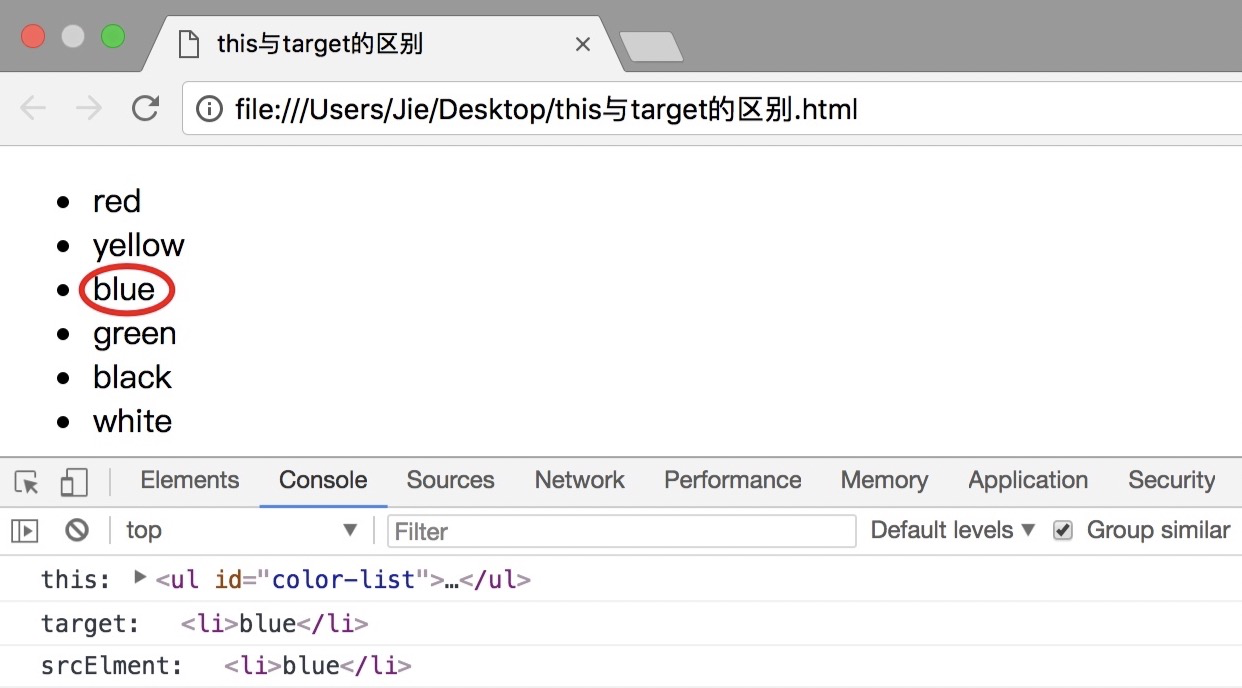
*DOM* 元素绑定事件时,事件处理函数里面的 *this* 指向绑定了事件的元素。
这个地方一定要注意它和 *target* 的区别,*target* 是指向触发事件的元素。
示例如下:
```html
- red
- yellow
- blue
- green
- black
- white
```
```js
// this 是绑定事件的元素
// target 是触发事件的元素 和 srcElememnt 等价
let colorList = document.getElementById("color-list");
colorList.addEventListener("click", function (event) {
console.log('this:', this);
console.log('target:', event.target);
console.log('srcElement:', event.srcElement);
})
```
当我点击如下位置时打印出来的信息如下:
 有些时候我们会遇到一些困扰,比如在 *div* 节点的事件函数内部,有一个局部的 *callback* 方法,该方法被作为普通函数调用时,*callback* 内部的 *this* 是指向全局对象 *window* 的
例如:
```html
有些时候我们会遇到一些困扰,比如在 *div* 节点的事件函数内部,有一个局部的 *callback* 方法,该方法被作为普通函数调用时,*callback* 内部的 *this* 是指向全局对象 *window* 的
例如:
```html
我是一个div
```
```js
window.id = 'window';
document.getElementById('div1').onclick = function(){
console.log(this.id); // div1
const callback = function(){
console.log(this.id); // 因为是普通函数调用,所以 this 指向 window
}
callback();
}
```
此时有一种简单的解决方案,可以用一个变量保存 *div* 节点的引用,如下:
```js
window.id = 'window';
document.getElementById('div1').onclick = function(){
console.log(this.id); // div1
const that = this; // 保存当前 this 的指向
const callback = function(){
console.log(that.id); // div1
}
callback();
}
```
### 改变 *this* 指向
#### 1. *call、apply、bind* 方法修改 *this* 指向
由于 *JavaScript* 中 *this* 的指向受函数运行环境的影响,指向经常改变,使得开发变得困难和模糊,所以在封装 *sdk* 或者写一些复杂函数的时候经常会用到 *this* 指向绑定,以避免出现不必要的问题。
*call、apply、bind* 基本都能实现这一功能,起到确定 *this* 指向的作用
***Function.prototype.call( )***
*call* 方法可以指定 *this* 的指向(即函数执行时所在的的作用域),然后再指定的作用域中,执行函数。
```js
var obj = {};
var f = function(){
return this;
};
console.log(f() === window); // this 指向 window
console.log(f.call(obj) === obj) // 改变this 指向 obj
```
上面代码中,全局环境运行函数 *f* 时,*this* 指向全局环境(浏览器为 *window* 对象);
*call* 方法可以改变 *this* 的指向,指定 *this* 指向对象 *obj*,然后在对象 *obj* 的作用域中运行函数 *f*。
*call* 方法的参数,应该是对象 *obj*,如果参数为空或 *null、undefind*,则默认传参全局对象。
```js
var n = 123;
var obj = { n: 456 };
function a() {
console.log(this.n);
}
a.call() // 123
a.call(null) // 123
a.call(undefined) // 123
a.call(window) // 123
a.call(obj) // 456
```
上面代码中,*a* 函数中的 *this* 关键字,如果指向全局对象,返回结果为 *123*。
如果使用 *call* 方法将 *this* 关键字指向 *obj* 对象,返回结果为 *456*。可以看到,如果 *call* 方法没有参数,或者参数为 *null* 或 *undefined*,则等同于指向全局对象。
如果 *call* 传参不是以上类型,则转化成对应的包装对象,然后传入方法。
例如,*5* 转成 *Number* 实例,绑定 *f* 内部 *this*
```js
var f = function () {
return this;
};
f.call(5); // Number {[[PrimitiveValue]]: 5}
```
*call* 可以接受多个参数,第一个参数是 *this* 指向的对象,之后的是函数回调所需的参数。
```js
function add(a, b) {
return a + b;
}
add.call(this, 1, 2) // 3
```
*call* 方法的一个应用是调用对象的原生方法。
```js
var obj = {};
obj.hasOwnProperty('toString') // false
// 覆盖掉继承的 hasOwnProperty 方法
obj.hasOwnProperty = function () {
return true;
};
obj.hasOwnProperty('toString') // true
Object.prototype.hasOwnProperty.call(obj, 'toString') // false
```
上面代码中 *hasOwnProperty* 是 *obj* 继承来的方法,用来判断对象是否包含自身特点(非继承)属性,但是 *hasOwnProperty* 并不是保留字,如果被对象覆盖,会造成结果错误。
*call* 方法可以解决这个问题,它将 *hasOwnProperty* 方法的原始定义放到 *obj* 对象上执行,这样无论 *obj* 上有没有同名方法,都不会影响结果。
***Function.prototype.apply( )***
*apply* 和 *call* 作用类似,也是改变 *this* 指向,然后调用该函数,唯一区别是 *apply* 接收数组作为函数执行时的参数。语法如下:
```js
func.apply(thisValue, [arg1, arg2, ...])
```
*apply* 方法的第一个参数也是 *this* 所要指向的那个对象,如果设为 *null* 或 *undefined*,则等同于指定全局对象。
第二个参数则是一个数组,该数组的所有成员依次作为参数,传入原函数。
原函数的参数,在 *call* 方法中必须一个个添加,但是在 *apply* 方法中,必须以数组形式添加。
```js
function f(x, y){
console.log(x + y);
}
f.call(null, 1, 1) // 2
f.apply(null, [1, 1]) // 2
```
利用这一特性,可以实现很多小功能。比如,输出数组的最大值:
```js
var a = [24,30,2,33,1]
Math.max.apply(null,a) //33
```
还可以将数组中的空值,转化成 *undefined*。
通过 *apply* 方法,利用 *Array* 构造函数将数组的空元素变成 *undefined*。
```js
var a = ['a',,'b'];
Array.apply(null,a) //['a',undefind,'b']
```
空元素与 *undefined* 的差别在于,数组的 *forEach* 方法会跳过空元素,但是不会跳过 *undefined*。因此,遍历内部元素的时候,会得到不同的结果。
```js
var a = ['a', , 'b'];
function print(i) {
console.log(i);
}
a.forEach(print)
// a
// b
Array.apply(null, a).forEach(print)
// a
// undefined
// b
```
配合数组对象的 *slice* 方法,可以将一个类似数组的对象(比如 *arguments* 对象)转为真正的数组。
```js
Array.prototype.slice.apply({0: 1, length: 1}) // [1]
Array.prototype.slice.apply({0: 1}) // []
Array.prototype.slice.apply({0: 1, length: 2}) // [1, undefined]
Array.prototype.slice.apply({length: 1}) // [undefined]
```
上面代码的 *apply* 方法的参数都是对象,但是返回结果都是数组,这就起到了将对象转成数组的目的。
从上面代码可以看到,这个方法起作用的前提是,被处理的对象必须有 *length* 属性,以及相对应的数字键。
***Function.prototype.bind( )***
*bind* 用于将函数体内的 *this* 绑定到某个对象,然后返回一个新函数
```js
var d = new Date();
d.getTime() // 1481869925657
var print = d.getTime;
print() // Uncaught TypeError: this is not a Date object.
```
报错是因为 *d.getTime* 赋值给 *print* 后,*getTime* 内部的 *this* 指向方式变化,已经不再指向 *date* 对象实例了。
解决方法:
```js
var print = d.getTime.bind(d);
print() // 1481869925657
```
*bind* 接收的参数就是所要绑定的对象
```js
var counter = {
count: 0,
inc: function () {
this.count++;
}
};
var func = counter.inc.bind(counter);
func();
counter.count // 1
```
绑定到其他对象
```js
var counter = {
count: 0,
inc: function () {
this.count++;
}
};
var obj = {
count: 100
};
var func = counter.inc.bind(obj);
func();
obj.count // 101
```
*bind* 还可以接收更多的参数,将这些参数绑定到原函数的参数
```js
var add = function (x, y) {
return x * this.m + y * this.n;
}
var obj = {
m: 2,
n: 2
};
var newAdd = add.bind(obj, 5);
newAdd(5) // 20
```
上面代码中,*bind* 方法除了绑定 *this* 对象,还将 *add* 函数的第一个参数 *x* 绑定成 *5*,然后返回一个新函数 *newAdd*,这个函数只要再接受一个参数 *y* 就能运行了。
如果 *bind* 方法的第一个参数是 *null* 或 *undefined*,等于将 *this* 绑定到全局对象,函数运行时 *this* 指向顶层对象(浏览器为 *window*)。
```js
function add(x, y) {
return x + y;
}
var plus5 = add.bind(null, 5);
plus5(10) // 15
```
上面代码中,函数 *add* 内部并没有 *this*,使用 *bind* 方法的主要目的是绑定参数 *x*,以后每次运行新函数 *plus5*,就只需要提供另一个参数 *y* 就够了。
而且因为 *add* 内部没有 *this*,所以 *bind* 的第一个参数是 *null*,不过这里如果是其他对象,也没有影响。
*bind* 方法有一些使用注意点。
(1)每一次返回一个新函数
*bind* 方法每运行一次,就返回一个新函数,这会产生一些问题。比如,监听事件的时候,不能写成下面这样。
```
element.addEventListener('click', o.m.bind(o));
```
上面代码中,*click* 事件绑定 *bind* 方法生成的一个匿名函数。这样会导致无法取消绑定,所以,下面的代码是无效的。
```js
element.removeEventListener('click', o.m.bind(o));
```
正确的方法是写成下面这样:
```js
var listener = o.m.bind(o);
element.addEventListener('click', listener);
// ...
element.removeEventListener('click', listener);
```
(2)结合回调函数使用
回调函数是 *JavaScript* 最常用的模式之一,但是一个常见的错误是,将包含 *this* 的方法直接当作回调函数。解决方法就是使用 *bind* 方法,将 *counter.inc* 绑定 *counter*。
```js
var counter = {
count: 0,
inc: function () {
'use strict';
this.count++;
}
};
function callIt(callback) {
callback();
}
callIt(counter.inc.bind(counter));
counter.count // 1
```
上面代码中,*callIt* 方法会调用回调函数。这时如果直接把 *counter.inc* 传入,调用时 *counter.inc* 内部的 *this* 就会指向全局对象。使用 *bind* 方法将 *counter.inc* 绑定 *counter* 以后,就不会有这个问题,*this* 总是指向 *counter*。
还有一种情况比较隐蔽,就是某些数组方法可以接受一个函数当作参数。这些函数内部的 *this* 指向,很可能也会出错。
```js
var obj = {
name: '张三',
times: [1, 2, 3],
print: function () {
this.times.forEach(function (n) {
console.log(this.name);
});
}
};
obj.print()
// 没有任何输出
```
上面代码中,*obj.print* 内部 *this.times* 的 *this* 是指向 *obj* 的,这个没有问题。
但是,*forEach* 方法的回调函数内部的 *this.name* 却是指向全局对象,导致没有办法取到值。稍微改动一下,就可以看得更清楚。
```js
obj.print = function () {
this.times.forEach(function (n) {
console.log(this === window);
});
};
obj.print()
// true
// true
// true
```
解决这个问题,也是通过 *bind* 方法绑定 *this*。
```js
obj.print = function () {
this.times.forEach(function (n) {
console.log(this.name);
}.bind(this));
};
obj.print()
// 张三
// 张三
// 张三
```
(3)结合 *call* 方法使用
利用 *bind* 方法,可以改写一些 *JavaScript* 原生方法的使用形式,以数组的 *slice* 方法为例。
```js
[1, 2, 3].slice(0, 1) // [1]
// 等同于
Array.prototype.slice.call([1, 2, 3], 0, 1) // [1]
```
上面的代码中,数组的 *slice* 方法从 *[1, 2, 3]* 里面,按照指定位置和长度切分出另一个数组。这样做的本质是在 *[1, 2, 3]* 上面调用 *Array.prototype.slice* 方法,因此可以用 *call* 方法表达这个过程,得到同样的结果。
*call* 方法实质上是调用 *Function.prototype.call* 方法,因此上面的表达式可以用 *bind* 方法改写。
```js
var slice = Function.prototype.call.bind(Array.prototype.slice);
slice([1, 2, 3], 0, 1) // [1]
```
上面代码的含义就是,将 *Array.prototype.slice* 变成 *Function.prototype.call* 方法所在的对象,调用时就变成了 *Array.prototype.slice.call*。类似的写法还可以用于其他数组方法。
```js
var push = Function.prototype.call.bind(Array.prototype.push);
var pop = Function.prototype.call.bind(Array.prototype.pop);
var a = [1 ,2 ,3];
push(a, 4)
a // [1, 2, 3, 4]
pop(a)
a // [1, 2, 3]
```
如果再进一步,将 *Function.prototype.call* 方法绑定到 *Function.prototype.bind* 对象,就意味着 *bind* 的调用形式也可以被改写。
```js
function f() {
console.log(this.v);
}
var o = { v: 123 };
var bind = Function.prototype.call.bind(Function.prototype.bind);
bind(f, o)() // 123
```
上面代码的含义就是,将 *Function.prototype.bind* 方法绑定在 *Function.prototype.call* 上面,所以 *bind* 方法就可以直接使用,不需要在函数实例上使用。
#### 2. 箭头函数的 *this* 指向
当我们的 *this* 是以函数的形式调用时,*this* 指向的是全局对象。
不过对于箭头函数来讲,却比较特殊。箭头函数的 *this* 指向始终为外层的作用域。
先来看一个普通函数作为对象的一个方法被调用时,*this* 的指向,如下:
```js
const obj = {
x : 10,
test : function(){
console.log(this); // 指向 obj 对象
console.log(this.x); // 10
}
}
obj.test();
// { x: 10, test: [Function: test] }
// 10
```
可以看到,普通函数作为对象的一个方法被调用时,*this* 指向当前对象。
在上面的例子中,就是 *obj* 这个对象,*this.x* 的值为 *10*。
接下来是箭头函数以对象的方式被调用的时候的 *this* 的指向,如下:
```js
var x = 20;
const obj = {
x: 10,
test: () => {
console.log(this); // {}
console.log(this.x); // undefined
}
}
obj.test();
// {}
// undefined
```
这里的结果和上面不一样,*this* 打印出来为 { },而 *this.x* 的值为 *undefined*。
为什么呢?
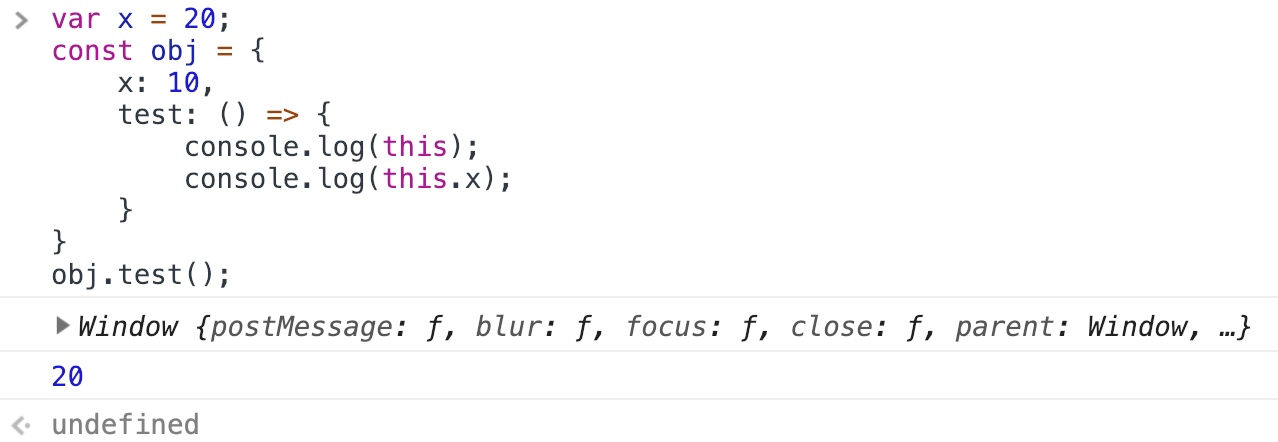
实际上刚才我们有讲过,箭头函数的 *this* 指向与普通函数不一样,它的 *this* 指向始终是指向的外层作用域。所以这里的 *this* 实际上是指向的全局对象。
如果证明呢?
方法很简单,将这段代码放入浏览器运行,在浏览器中用 *var* 所声明的变量会成为全局对象 *window* 的一个属性,如下:
 接下来我们再来看一个例子,来证明箭头函数的 *this* 指向始终是指向的外层作用域。
```js
var name = "JavaScript";
const obj = {
name: "PHP",
test: function () {
const i = function () {
console.log(this.name);
// i 是以函数的形式被调用的,所以 this 指向全局
// 在浏览器环境中打印出 JavaScript,node 里面为 undeifned
}
i();
}
}
obj.test(); // JavaScript
```
接下来我们将 i 函数修改为箭头函数,如下:
```js
var name = "JavaScript";
const obj = {
name : "PHP",
test : function(){
const i = ()=>{
console.log(this.name);
// 由于 i 为一个箭头函数,所以 this 是指向外层的
// 所以 this.name 将会打印出 PHP
}
i();
}
}
obj.test();// PHP
```
最后需要说一点的就是,箭头函数不能作为构造函数,如下:
```js
const Test = (name, age) => {
this.name = name;
this.age = age;
};
const test = new Test("xiejie", 18);
// TypeError: Test is not a constructor
```
## 真题解答
- *this* 的指向哪几种 ?
> 参考答案:
>
> 总结起来,*this* 的指向规律有如下几条:
>
> - 在函数体中,非显式或隐式地简单调用函数时,在严格模式下,函数内的 *this* 会被绑定到 *undefined* 上,在非严格模式下则会被绑定到全局对象 *window/global* 上。
> - 一般使用 *new* 方法调用构造函数时,构造函数内的 *this* 会被绑定到新创建的对象上。
> - 一般通过 *call/apply/bind* 方法显式调用函数时,函数体内的 *this* 会被绑定到指定参数的对象上。
> - 一般通过上下文对象调用函数时,函数体内的 *this* 会被绑定到该对象上。
> - 在箭头函数中,*this* 的指向是由外层(函数或全局)作用域来决定的。
-*EOF*-
接下来我们再来看一个例子,来证明箭头函数的 *this* 指向始终是指向的外层作用域。
```js
var name = "JavaScript";
const obj = {
name: "PHP",
test: function () {
const i = function () {
console.log(this.name);
// i 是以函数的形式被调用的,所以 this 指向全局
// 在浏览器环境中打印出 JavaScript,node 里面为 undeifned
}
i();
}
}
obj.test(); // JavaScript
```
接下来我们将 i 函数修改为箭头函数,如下:
```js
var name = "JavaScript";
const obj = {
name : "PHP",
test : function(){
const i = ()=>{
console.log(this.name);
// 由于 i 为一个箭头函数,所以 this 是指向外层的
// 所以 this.name 将会打印出 PHP
}
i();
}
}
obj.test();// PHP
```
最后需要说一点的就是,箭头函数不能作为构造函数,如下:
```js
const Test = (name, age) => {
this.name = name;
this.age = age;
};
const test = new Test("xiejie", 18);
// TypeError: Test is not a constructor
```
## 真题解答
- *this* 的指向哪几种 ?
> 参考答案:
>
> 总结起来,*this* 的指向规律有如下几条:
>
> - 在函数体中,非显式或隐式地简单调用函数时,在严格模式下,函数内的 *this* 会被绑定到 *undefined* 上,在非严格模式下则会被绑定到全局对象 *window/global* 上。
> - 一般使用 *new* 方法调用构造函数时,构造函数内的 *this* 会被绑定到新创建的对象上。
> - 一般通过 *call/apply/bind* 方法显式调用函数时,函数体内的 *this* 会被绑定到指定参数的对象上。
> - 一般通过上下文对象调用函数时,函数体内的 *this* 会被绑定到该对象上。
> - 在箭头函数中,*this* 的指向是由外层(函数或全局)作用域来决定的。
-*EOF*-